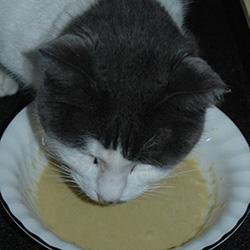
Our homemade Cat Food Stew is fully cooked and is specially formulated to support feline kidney health. Tunia enjoys his meal.
Introduction
Many of you may have seen numerous reports this year outlining the deaths of pets, particularly cats, as a result of avian flu contamination. Although cats are more severely impacted than dogs, both are at risk. The current H5N1 flu variant has been particularly aggressive, causing the FDA to issue a call for all pet food manufacturers producing raw food for cats and dogs to re-analyze their products, and even some full product recalls for unsafe food. For those of us that have fed our cats or dogs raw food in the past, as our Director Leslie has, these developments can be particularly scary and mean a re-evaluation of household practices.
What is H5N1?
H5N1 is a strain of influenza, or flu, that is highly pathogenic. In other words, it is highly contagious and causes severe disease. You may have also seen it referred to as HPAI, or Highly Pathogenic Avian Influenza. H5N1, or bird flu, originated in wild populations of birds, and now that we are in the middle of migratory season, wild birds will be settling down to their winter nesting grounds, potentially spreading this flu further. One of the major considerations of H5N1 or HPAI is the fact that it appears to be zoonotic, or it has the ability to move from one species, such as a bird, to another, such as a cat, dog, or even cow (Dhakal et al.). Although the likelihood of transmission to humans is low, the CDC continues to urge pet owners and those who live and work closely with birds and livestock to take extra care; because H5N1 has proven to be highly contagious across species, it is still possible for humans to contract it– at least one veterinarian has already gotten it and came down with mild flu symptoms.
Why is Avian Flu in My Pet Food?
This is a great question. If you feed cooked food or kibble, which is processed at high temperatures, you are unlikely to find avian flu in your pet food. This is because viruses do not like high temperatures and become inactive when exposed to them (scientific side note, us biologists say inactive instead of dead because we don’t consider viruses to be alive in the first place!). Raw food, however, is different. In raw food, both the meat and the virus remain intact. So, if the feed animal, such as a chicken, had the virus when it was alive, there is the possibility of passing it along after the animal dies and becomes your pet’s dinner. Unfortunately, because this flu is so contagious, the likelihood of passing it along is higher than usual. The two biggest culprits right now for avian flu transmission are raw pet food and raw milk. Remember, this flu can travel across species and impact dairy cattle, too, so unpasteurized milk, which is not heated to a high temperature like pasteurized milk, is also potentially dangerous.
What Are the Symptoms of Avian Flu?
According to the Oregon Department of Agriculture (ODA), symptoms in cats include:
- Fever
- Lack of energy
- Lack of appetite
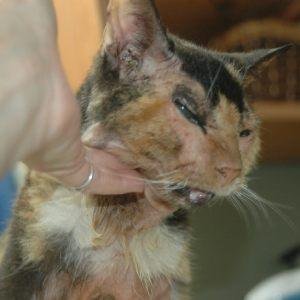
- Conjunctivitis or pink eye
- Eye and/or nasal discharge
- Difficulty breathing
- Neurological signs (e.g., tremors, seizures, incoordination, or blindness)
- Death
In other animals, like dogs, the ODA states that symptoms will be similar. The best way to prevent your cat or other pet from contracting avian flu is by feeding cooked, not raw food, including pasteurized milk. Limit exposure to wild birds or domestic birds who show symptoms. Keep your pets indoors, and if you take them outside, monitor them and keep them away from dead animals. If your pet has any of the above symptoms, take them to the vet immediately. It’s better to be safe than sorry.
References
CDC. “Bird Flu in Pets and Other Animals.” Mar. 7, 2025. https://www.cdc.gov/bird-flu/risk-factors/bird-flu-in-pets.html
European Food Safety Authority. “Unprecedented high level of highly pathogenic avian influenza in wild birds in Europe during the 2025 autumn migration.” Nov. 24, 2025.
https://www.efsa.europa.eu/en/efsajournal/pub/9811
FDA. “Cat and Dog Food Manufacturers Required to Consider H5N1 in Food Safety Plans.” Jan. 17, 2025. Updated Sept. 30, 2025. https://www.fda.gov/animal-veterinary/cvm-updates/cat-and-dog-food-manufacturers-required-consider-h5n1-food-safety-plans
Janak Dhakal, Sushant Bhat, Joe James, Richard Y. Otwey, Sandesh Chapagain, Parminder Singh. “Highly Pathogenic Avian Influenza (HPAI) H5N1 in Raw Pet Foods and Milk: A Growing Threat to both Companion Animals and Human Health, and Potential Raw Pet Food Industry Liability.” Journal of Food Protection, Volume 88, Issue 11, 2025, 100628. ISSN 0362-028X. https://doi.org/10.1016/j.jfp.2025.100628.
Oregon Department of Agriculture. “HPAI in Pets.” Undated. Accessed 12/03/2025. https://www.oregon.gov/oda/animal-health-feeds-livestock-id/animal-diseases/avian-influenza/pages/hpai-pets.aspx